The IT staffing market feels a lot more selective than it did a few years ago — but it’s not quiet. It’s shifting. Companies are still hiring, but they’re getting sharper about
what they need,
how they hire, and
when they bring in full-time versus contract talent. At the same time, candidates are adapting fast, especially around AI skills, flexibility, and how they prove they can actually do the work. Recent data from ASA and LinkedIn, CompTIA, Gallup, Upwork, and LinkedIn’s own recruiting research all point in the same direction: the market is less about volume now and more about precision. (
americanstaffing.net)
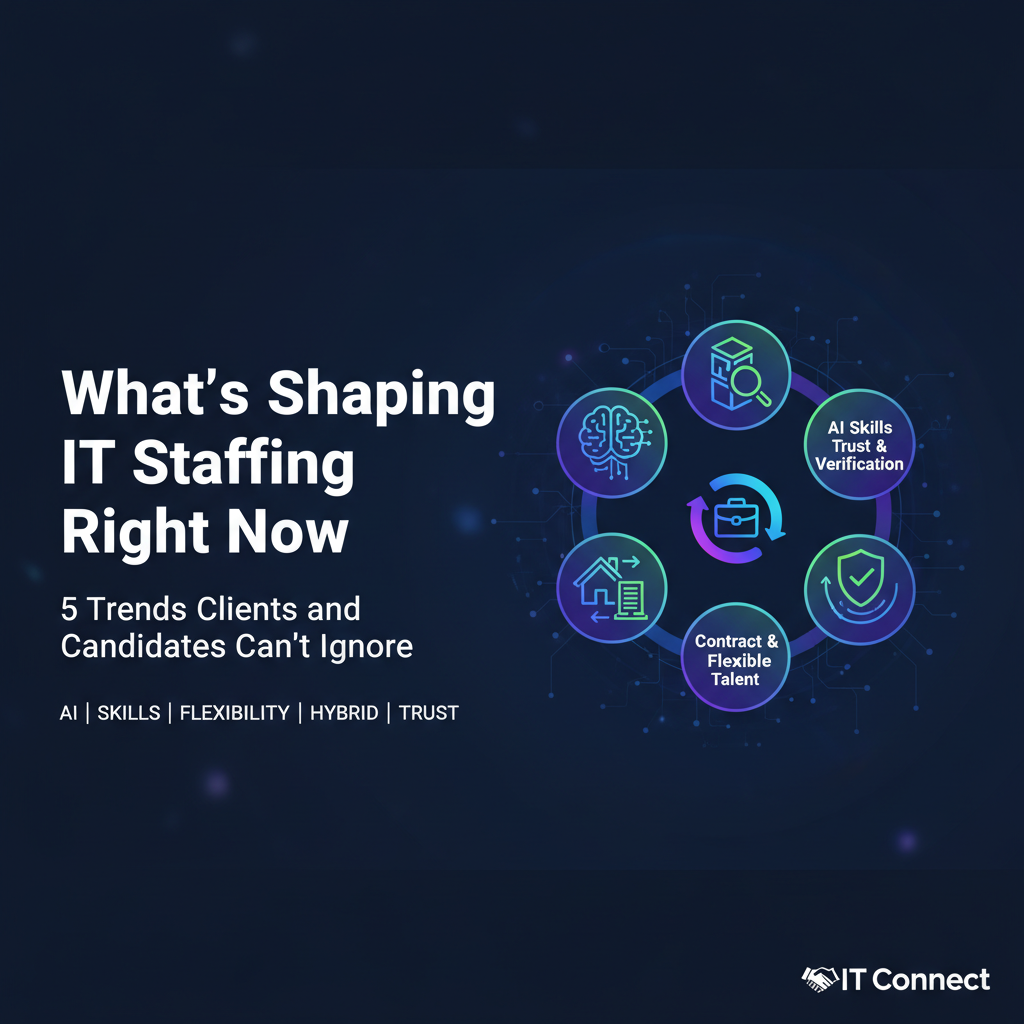
1) AI is no longer a niche skill — it’s becoming table stakes
If you work in IT staffing, you can feel this trend without opening a single report: clients want AI fluency, even when the role itself isn’t labeled “AI.” CompTIA reported nearly 125,000 active U.S. job postings referencing AI skills in May 2025, showing just how broadly AI demand is spreading across tech hiring. On the staffing side, ASA and LinkedIn found that workers placed through staffing firms added AI literacy skills faster than the broader LinkedIn population, and 2025 contract job postings on LinkedIn rose 7% year over year even as overall postings declined. (
comptia.org)
That matters for staffing firms because clients are not just asking for developers anymore. They’re asking for engineers, analysts, architects, product people, and project leaders who can work in an AI-shaped environment. The takeaway is simple: the strongest candidate pipelines now combine technical depth with practical AI fluency.
2) Skills-based hiring is moving from “nice idea” to real hiring practice
The old habit of filtering by pedigree is losing ground. LinkedIn’s 2025 Future of Recruiting report shows that talent teams increasingly see skills assessment as critical to better hiring, and companies using the most skills-based searches are 12% more likely to make a quality hire. The same report also notes that among talent teams already using or testing generative AI, some of the time saved is being redirected into candidate screening and skill assessment. (
business.linkedin.com)
For IT staffing, this is a big shift. It favors recruiters and account managers who can validate capability, not just keyword-match a resume. Hiring managers are more open to candidates with nontraditional backgrounds if they can prove they can ship code, secure systems, manage cloud environments, or lead implementations. In practice, that means assessment-first recruiting, tighter screening, and better intake conversations with clients.
3) Contract and flexible talent are becoming a strategic lever
One of the clearest signals in the market is that companies want agility. ASA and LinkedIn found contract job postings rose every year from 2023 through 2025 on LinkedIn. Upwork’s 2025 Future Workforce Index adds another layer: 28% of U.S. skilled knowledge workers now work independently, and AI-related work volume on Upwork grew 60% year over year in 2024. Nearly half of businesses surveyed by Upwork said they turn to freelancers to address critical skill gaps. (
americanstaffing.net)
This doesn’t mean full-time hiring is disappearing. It means clients are getting more intentional about team design. Instead of defaulting to permanent headcount, many are blending core employees with contract specialists for cloud migrations, security initiatives, AI rollouts, platform upgrades, and time-bound transformation work. For staffing partners, that opens the door to broader conversations about workforce planning — not just requisition filling.
4) Flexibility is still a hiring advantage
Even with some return-to-office pressure across the market, flexibility remains a major talent lever. Gallup reports that most remote-capable employees are currently working hybrid or fully remote, six in 10 want a hybrid arrangement, and six in 10 fully remote employees say they are extremely likely to look for another job if remote flexibility is taken away. (
gallup.com)
For IT staffing firms, this is practical, not philosophical. If a client insists on a rigid onsite model for a role that could be hybrid or remote, the candidate pool usually gets smaller and harder to close. The most competitive employers are being clearer about what must happen onsite, what can happen remotely, and what flexibility they are truly willing to offer.
5) Trust and verification are becoming part of recruiting itself
There’s another shift that doesn’t get enough attention: trust. As recruiting gets more digital and more AI-assisted, candidates are more cautious. ASA reported that nearly half of employed U.S. job seekers believe AI recruiting tools are more biased than human recruiters. Meanwhile, LinkedIn says more than 80 million people have verified on the platform, using identity, workplace, or education verification to signal authenticity. (
americanstaffing.net)
For staffing companies, this raises the bar on candidate experience. Clear communication, transparent job details, credible recruiter profiles, and human follow-up all matter more now. In a market full of noise, trust is becoming a differentiator.
Final thought
The IT staffing firms that win in this market won’t just move fast. They’ll be the ones that understand how these trends connect: AI demand, skills-first hiring, flexible team models, candidate expectations around work, and the growing need for trust in the recruiting process. At Calibro Corp, that’s the opportunity — helping clients build smarter teams and helping candidates connect to roles where their real skills can stand out.
If your team is hiring for AI, cloud, cybersecurity, software, or hard-to-fill technical roles, Calibro Corp can help you build a staffing strategy that fits the market you’re actually in — not the one that existed two years ago.
.png)





.svg)