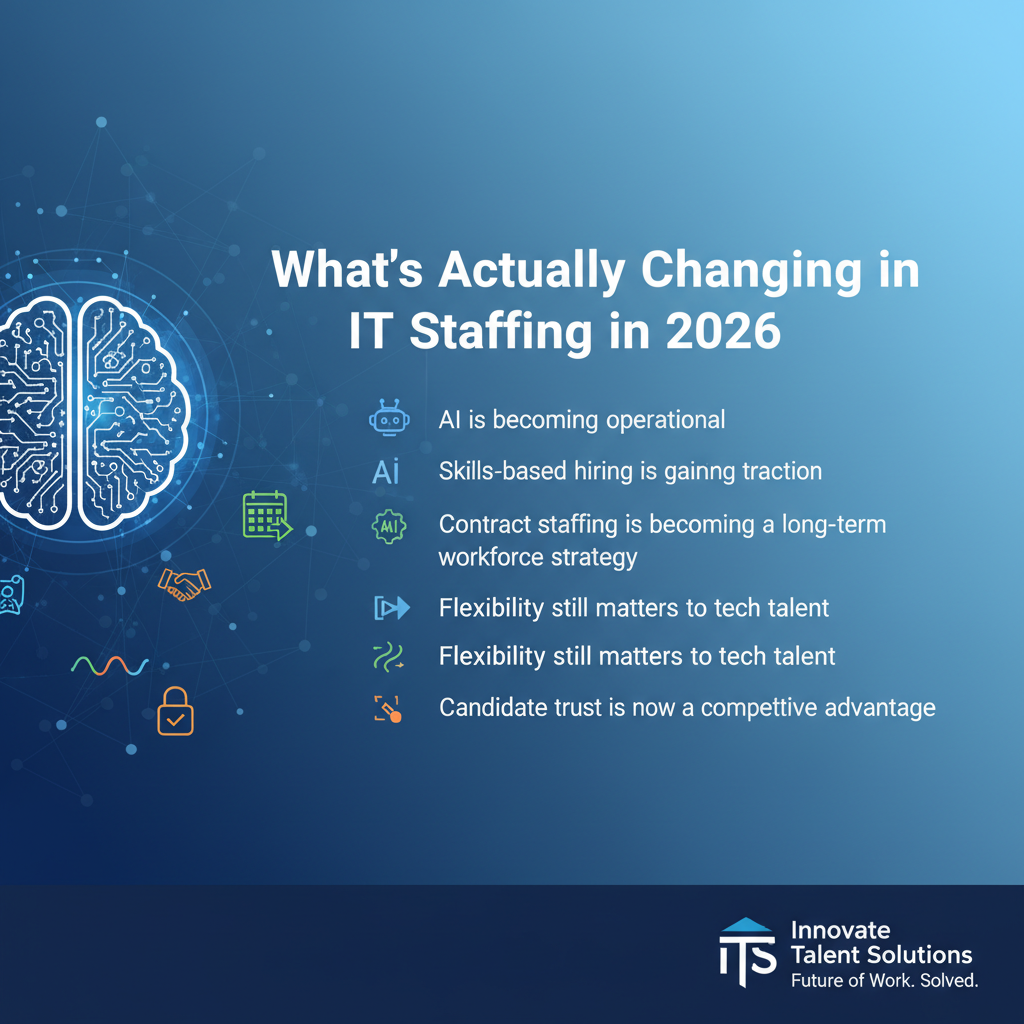
The IT staffing market feels different right now—and not just because everyone is talking about AI. The bigger shift is that clients are becoming more selective, candidates are more skeptical, and staffing firms are being pushed to prove value faster. Recent industry research points to a few clear themes: AI is moving from experiment to operating model, skills-based hiring is becoming more practical, contract work is sticking around as a core workforce strategy, flexibility still matters, and candidate trust is now a real differentiator. (
bullhorn.com)
1) AI is no longer a side project
If 2024 was the “let’s test some tools” phase, 2025 turned AI into a real operating priority for recruiting and staffing teams. Bullhorn’s 2026 Recruitment Industry Trends Report says top-performing firms were four times as likely to be using AI, and 55% said AI screening alone increased KPIs by more than 25%. LinkedIn’s 2025 Future of Recruiting report also shows staffing leaders see AI less as a novelty and more as a way to improve efficiency, candidate sourcing, and quality of hire. (
bullhorn.com)
For IT staffing companies, the takeaway is simple: AI should handle the repetitive work—search refinement, summaries, first-pass screening, scheduling, follow-up—so recruiters can spend more time qualifying real technical fit and advising hiring managers. The firms getting the most from AI are not removing humans from the process; they’re using AI to make human judgment more useful. (
bullhorn.com)
2) Skills-based hiring is getting more real
This trend has been discussed for years, but the data suggests it is becoming more actionable now. LinkedIn’s staffing-focused Future of Recruiting report says 72% of recruiting pros believe AI can improve how candidate skills are assessed, and 62% say improving skills assessment will be a priority over the next 12–18 months. That matters in IT, where job titles often hide more than they reveal. A “software engineer” can mean five very different capability profiles depending on stack, architecture experience, and delivery environment. (
business.linkedin.com)
For staffing firms, this means sharper intake conversations, better technical screening, and more confidence presenting nontraditional candidates who can do the work even if their resume doesn’t follow the expected path. Skills-based hiring is especially valuable when clients need hard-to-find talent in AI, cybersecurity, data, cloud, and platform engineering. CompTIA reported nearly 125,000 active AI-related job postings in May 2025 alone, which shows how quickly demand is concentrating around specific technical capabilities. (
comptia.org)
3) Contract staffing is not temporary strategy anymore
One of the most important shifts in staffing is that contract labor is being treated less like a stopgap and more like a long-term workforce model. In the LinkedIn and American Staffing Association State of Staffing & Search report, contract-to-permanent conversion rates fell from 56% in 2016 to 14% in 2025, while the report explicitly notes that employers are embedding contract roles into long-term labor models. In other words, a lot of companies are no longer using contract roles only as a bridge to full-time hiring. (
economicgraph.linkedin.com)
That is especially relevant in IT staffing, where companies want access to specialized talent without overcommitting during uncertain budgeting cycles. It also aligns with broader labor-market caution: BLS reported that temporary help services had shed 640,000 jobs from the March 2022 peak through June 2025, showing how selective and cost-conscious the market has become. (
bls.gov)
4) Flexibility still wins candidates
Remote work is no longer the headline it was two years ago, but it is still a deciding factor for many tech professionals. LinkedIn and ASA found that 30% of positions added by people with staffing-industry backgrounds were fully remote, versus 22% across all positions added. Hybrid held steady, while onsite roles were more common overall than in staffing-related moves. (
economicgraph.linkedin.com)
For IT staffing firms, that means clients still need to be realistic. If the role can be remote or hybrid, say so clearly. If it cannot, explain why. Ambiguity slows response rates and hurts trust.
5) Candidate trust is becoming a competitive advantage
This may be the most overlooked trend of all. Dice’s 2025 tech hiring research found 68% of tech professionals distrust fully AI-driven hiring processes, while hybrid models that combine AI with human oversight earn much stronger trust. The same research found candidates respond best to clear requirements, prompt communication, human review, salary transparency, and transparent evaluation criteria. (
businesswire.com)
That is a huge opportunity for staffing firms. In a market where job seekers often feel like they are sending resumes into a black hole, recruiters who communicate clearly and give grounded feedback stand out fast.
Conclusion
The firms that will win in IT staffing this year are not the ones chasing every new tool. They are the ones combining smart automation with sharper skills validation, honest client guidance, flexible workforce models, and a better candidate experience. That mix is what turns a staffing vendor into a trusted hiring partner. (
bullhorn.com)
If Calibro Corp is helping companies build stronger technical teams, this is the moment to lean into that role: move faster, screen smarter, communicate better, and make the hiring process feel human again.
.png)





.svg)