February 15, 2026
IT Staffing in 2026: Agentic AI, Skills-First Hiring, and the New Compliance Playbook
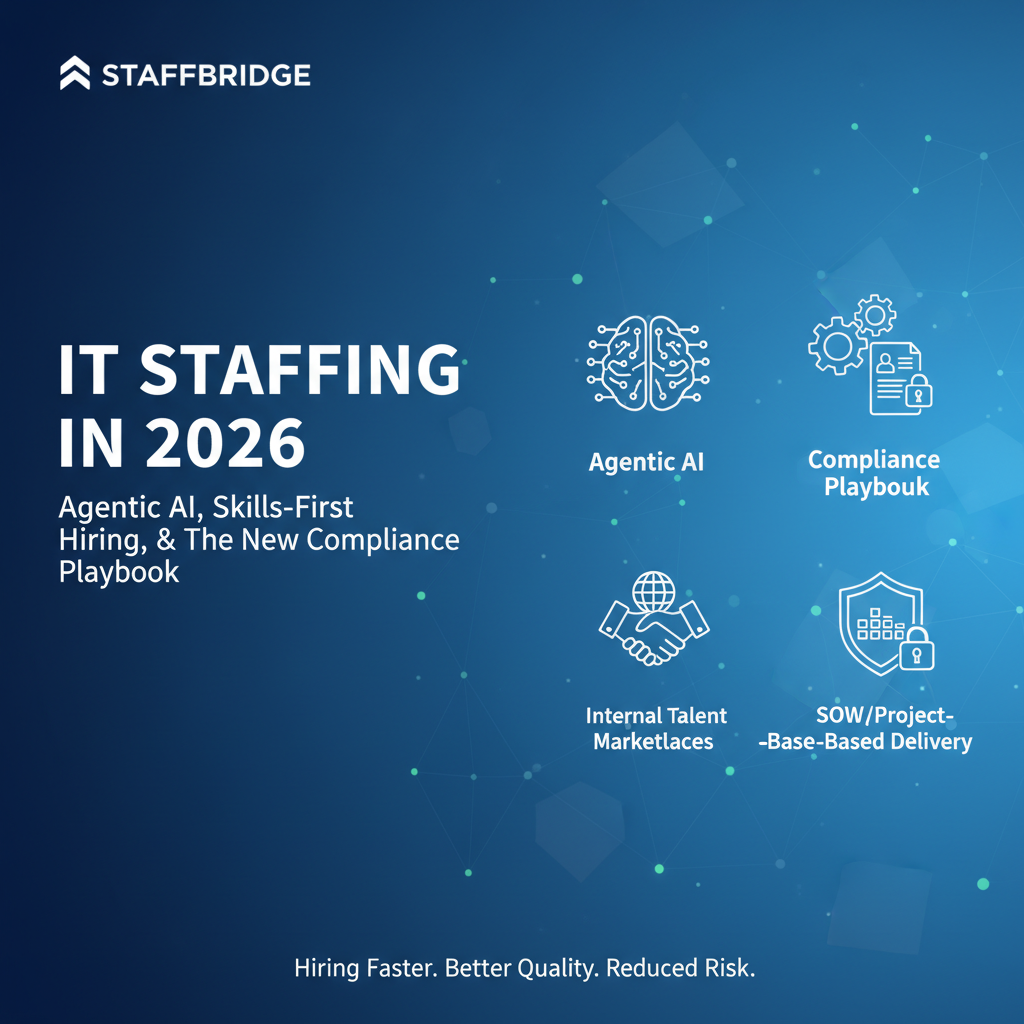
IT staffing in 2026 is being reshaped by agentic AI in recruiting, skills-based hiring, and higher expectations for compliance and transparency (AEDT audits and pay transparency). At the same time, internal talent marketplaces and SOW/project-based delivery are changing how companies buy talent. This article outlines the biggest shifts and a practical playbook for hiring faster while improving quality and reducing risk.
IT Staffing in 2026: Agentic AI, Skills-First Hiring, and the New Compliance Playbook
The IT hiring market in 2026 is defined by a simple reality: companies still need specialized talent (cloud, data, security, AI), but they’re under pressure to hire faster, prove quality, and reduce risk. That’s pushing staffing and recruiting teams toward three big shifts: AI moving from “assist” to “execute,” skills-based hiring becoming the default, and compliance/experience becoming a differentiator—not an afterthought.
Below are the trends we’re seeing most in IT staffing and team augmentation—and how to translate them into better placements and stronger retention.
1) Recruiting AI moves into production (and becomes “agentic”)
Generative AI adoption in recruiting has accelerated from experimentation to real workflows, especially in high-volume sourcing, screening, and scheduling. LinkedIn reports broad exploration/implementation of generative AI across recruitment firms, and Gartner highlights an “AI-first” shift in high-volume recruiting for 2026. (business.linkedin.com)
What’s new in 2026 is the growing expectation for agentic AI—tools that can complete multi-step tasks (like sourcing shortlists, sending outreach, coordinating calendars) with minimal prompting. (imocha.io)
What it means for staffing firms:
Recruiters spend less time on repetitive workflows and more time on consultative work: intake calibration, candidate coaching, and stakeholder management.
Differentiation shifts toward process quality (structured interviews, job scorecards, skills validation) and trust (clear disclosure of AI use, human review).
2) Skills-based hiring becomes the core operating system
The shift from credential-based screening to skills-first hiring continues to expand—especially for IT roles where projects, portfolios, certifications, and hands-on assessments outperform title-based assumptions. LinkedIn’s staffing edition emphasizes skills-based hiring and quality-of-hire as major priorities as AI becomes embedded in recruiting. (business.linkedin.com)
In practice, this means job descriptions are evolving into capability maps (what you can do) rather than requirements lists (what you’ve done). Several 2026 trend roundups highlight the move toward skills-over-credentials and skills replacing job titles. (learn.g2.com)
How Calibro Corp can lean in:
Standardize role intake with a short skills rubric (must-have, strong-plus, nice-to-have) tied to real deliverables.
Use lightweight, role-relevant validation (short technical screens, scenario-based questions, work-sample review).
Present candidates in a skills-forward profile (proof points + outcomes) instead of a resume-first narrative.
3) Compliance and transparency become competitive advantages
As more organizations use automated tools in hiring, compliance expectations rise. In New York City, Local Law 144 requires annual bias audits and candidate notices for automated employment decision tools (AEDTs). (nyc.gov)
At the same time, pay transparency laws continue spreading across U.S. states, affecting how employers write job ads, disclose ranges, and communicate benefits. (forbes.com)
Staffing impact:
Clients increasingly want partners who can help them standardize job postings, document selection steps, and maintain defensible processes.
Candidates expect clarity: salary ranges, interview steps, response timelines, and how AI is used.
4) Internal mobility and talent marketplaces reshape “build vs. buy”
Hiring managers are being asked to look inward first—redeploying existing employees via internal mobility programs and talent marketplaces before opening external reqs. This trend is accelerating as skills shortages persist and hiring costs remain under scrutiny. (phenom.com)
What that means for external staffing:
External hiring often becomes more specialized: niche skill sets, urgent delivery, or roles that internal talent can’t cover quickly.
Staffing firms that win are those who integrate smoothly with internal TA, HR, and workforce planning—bringing candidates who are immediately relevant and validated.
5) Project-based staffing grows (SOW, pods, and outcome delivery)
Many organizations are shifting budget from “headcount roles” to project outcomes, increasing Statement of Work (SOW) usage inside contingent programs. One MSP-focused analysis notes SOW as a rising share of MSP spend. (broadleafresults.com)
Opportunity for IT staffing:
Offer “team staffing” options: a delivery pod (e.g., cloud migration squad, data engineering pod, app modernization team) with clear milestones.
Build repeatable playbooks for the highest-demand domains: cloud, security, data, and AI enablement.
6) Hybrid expectations keep shifting—sometimes quietly
While remote work remains important to many candidates, more employers are tightening in-office requirements through incremental policy changes (“hybrid creep”). (forbes.com)
What works in 2026:
Be explicit early: location, in-office cadence, travel, time zone requirements.
Expand candidate pools intelligently: relocate-ready talent, regional hubs, and (when appropriate) distributed teams.
What to do next (a practical 2026 playbook)
To compete in 2026, IT staffing teams need to combine speed with credibility:
Codify skills-first intake (scorecards + deliverables).
Use AI to remove friction (sourcing, scheduling, summaries) while keeping humans accountable for decisions. (gartner.com)
Treat compliance as part of delivery (transparent process, pay range clarity, AI-tool governance). (nyc.gov)
Package talent as outcomes (pods, SOW, rapid-response teams) for clients who need measurable progress—not just resumes. (broadleafresults.com)
Conclusion: The winning staffing partners will be the ones clients can trust
In 2026, clients want fewer surprises: validated skills, predictable delivery, and a process that stands up to scrutiny. Candidates want clarity, speed, and respect. The staffing firms that align both sides—using AI responsibly, hiring for skills, and operationalizing transparency—will win.
If you’re rethinking your 2026 hiring strategy, Calibro Corp can help you build skills-based shortlists, stand up project teams, and improve speed-to-fill without sacrificing quality. Contact us to talk through your upcoming roles and delivery goals.
.png)





.svg)