The IT staffing market is entering 2026 with a clearer mandate: move faster, hire smarter, and stay flexible. Recent industry research shows that AI is changing recruiter workflows, skills-based hiring is becoming more important, and contract talent is no longer a stopgap — it is increasingly part of long-term workforce strategy. At the same time, employers are still wrestling with persistent skills gaps in high-demand areas like AI, cybersecurity, and cloud. (
business.linkedin.com)
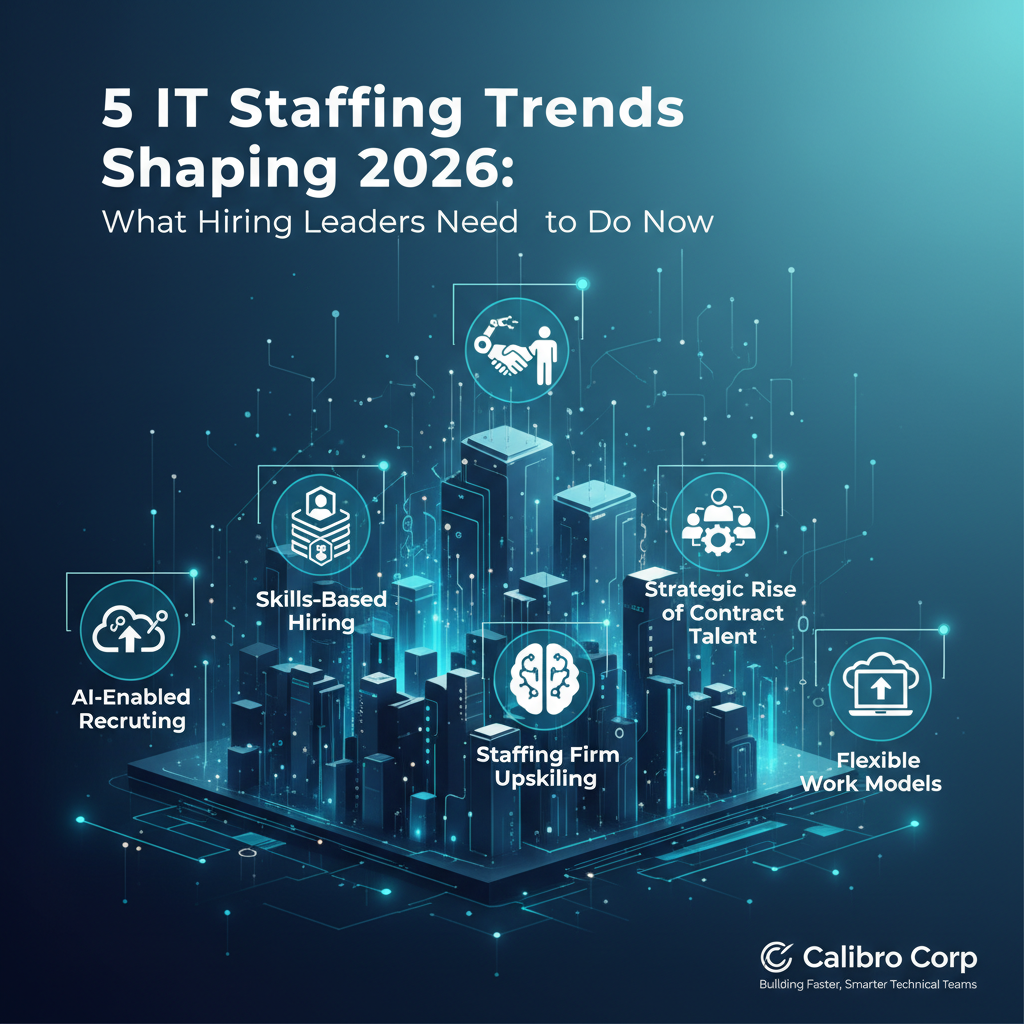
1) AI is moving from experiment to everyday recruiting tool
LinkedIn’s 2025 staffing-focused recruiting report shows AI is being used to improve hiring efficiency, job post effectiveness, talent pool expansion, quality of hire, and candidate experience. In that same report, 72% of recruiting professionals said improving how candidates’ skills are assessed will be a priority over the next 12–18 months, and 62% said AI can improve measurement of quality of hire. For IT staffing firms, that means AI is no longer just about speed; it is becoming part of how recruiters validate fit, prioritize candidates, and advise clients more strategically. (
business.linkedin.com)
The bigger takeaway is that AI should enhance recruiter judgment, not replace it. As automation handles more repetitive tasks, human recruiters become more valuable where it matters most: context, relationship-building, and consultative hiring conversations. (
business.linkedin.com)
2) Skills-based hiring is becoming the default for technical roles
The shift from pedigree to proven capability continues to accelerate. LinkedIn’s recruiting research highlights skills-based hiring as a rising priority, and notes that degree requirements have been loosening over time. Meanwhile, the World Economic Forum reports that nearly 40% of skills required on the job are expected to change by 2030, with 63% of employers already identifying skills gaps as a major barrier to transformation. (
business.linkedin.com)
For Calibro Corp and similar firms, this creates a strong opportunity: clients need partners who can translate business needs into skills maps, not just job descriptions. The most competitive staffing firms will be the ones that can present skills-validated candidates for evolving roles in AI, cloud, data, cybersecurity, and modernization initiatives. (
weforum.org)
3) Contract staffing is now a strategic workforce lever
One of the clearest trends in the latest staffing data is the continued rise of contract work. LinkedIn’s 2026 State of Staffing & Search report found that the share of contract postings rose 24% between June 2022 and June 2023, then increased another 10% in 2024 and 7% in 2025. The report frames contract work as central, not peripheral, to employer labor models. Dice’s 2025 announcement expanding into contract tech talent echoes that shift, citing demand for faster access to specialized professionals in AI, cybersecurity, and cloud computing. (
economicgraph.linkedin.com)
This matters because IT leaders are under pressure to deliver projects without overcommitting fixed headcount. Contract and contract-to-hire models give companies a way to add scarce expertise quickly, de-risk uncertain demand, and keep transformation work moving. (
economicgraph.linkedin.com)
4) AI and technical upskilling are becoming differentiators inside staffing itself
The staffing industry is not just recruiting AI talent; it is also building AI capability internally. LinkedIn’s February 2026 staffing report found that staffing professionals added AI literacy skills 46% more often than LinkedIn members overall in 2025, and by 2025 they were also adding AI engineering skills 7% more often than the broader member base. That suggests staffing firms are investing in stronger technical fluency so they can better evaluate candidates and support AI-driven hiring demand. (
economicgraph.linkedin.com)
For clients, this raises expectations. They increasingly want staffing partners who understand the difference between adjacent and production-ready skills, can assess transferable capability, and can coach hiring managers on what “good” looks like in a rapidly changing tech landscape. (
economicgraph.linkedin.com)
5) Flexibility still matters — for employers and candidates
Flexibility remains a meaningful part of the staffing value proposition. LinkedIn’s 2026 staffing report found that among workers who added a new role after previous experience in staffing and recruiting, 30% added fully remote roles versus 22% across all members. The same report suggests contract work is attracting groups that often value flexibility, including women and Millennials. (
economicgraph.linkedin.com)
For IT staffing firms, the implication is straightforward: workforce strategy conversations should include workplace model, project structure, and speed-to-productivity — not just compensation and title. Clients that align role design with how skilled tech professionals want to work will have a better chance of landing in-demand talent. (
economicgraph.linkedin.com)
Conclusion: The winning staffing partner is more strategic than transactional
The firms that stand out in 2026 will not be the ones sending the most resumes. They will be the ones combining AI-enabled efficiency, skills-first evaluation, contract staffing agility, and market insight to help clients build stronger teams faster. The latest research points in the same direction: hiring is becoming more data-driven, more specialized, and more flexible. (
business.linkedin.com)
At Calibro Corp, this is the moment to lead with consultative expertise. If your organization is hiring for AI, cloud, cybersecurity, software delivery, or hard-to-fill technical roles, let’s talk about how a smarter staffing strategy can help you scale with confidence. (
dice.com)
.png)





.svg)